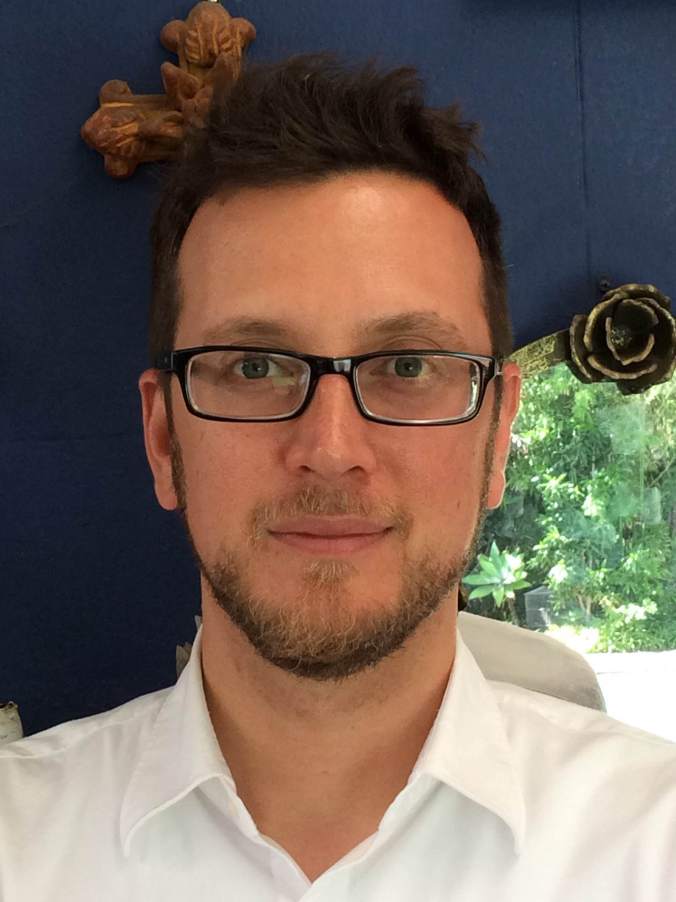
IN his book, South Africa’s Insurgent Citizens, Julian Brown has chosen to look at the actions of ordinary South Africans across the country in an effort to understand contemporary politics from a ground-level perspective.
It’s a timely release given the recent #FeesMustFall protests which erupted on university campuses across South Africa recently.
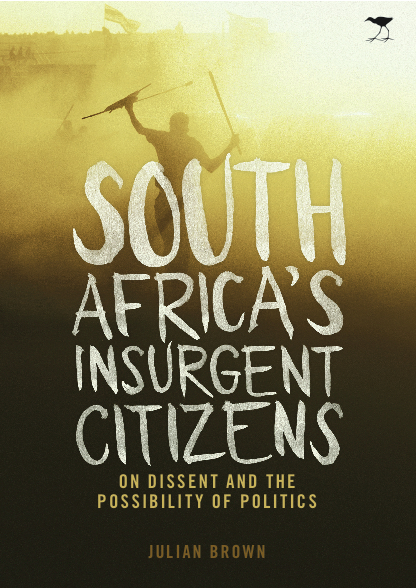
Looking back over South Africa’s first 20 years of democracy, the Durban-born author argues that politics is alive and well in this country — if you know where to look. It can be found in the streets and courtrooms, and has been created by a new kind of citizen, one that is neither respectful nor passive, but insurgent.
“I wrote this book because I believe that there is a need to change how we think about politics in South Africa,” says Brown of South Africa’s Insurgent Citizens.
“Up until very recently, the majority of political analyses have been focused on the fragmentation of the political elite; the splits between the President and his supporters within the ANC, for example.
“This means that the political actions of most South Africans have been largely overlooked, or, if looked at all, seen only in moments of exceptional activity, like mass protest.
“In this book, I try to change the focus: instead of looking at the top of the government, I look at the actions of ordinary South Africans across the country and try to understand contemporary politics from that perspective.”
Brown opens South Africa’s Insurgent Citizens with a discussion of the Marikana massacre.
“This is the single most important political event of the past few years,” he says. “It was a large, unauthorised labour protest that was brutally and violently suppressed by the state.
“It demonstrates both the potential power of insurgent citizenship — that is, of people acting outside of the authorised forms of engagement — and the potential dangers of acting in this way: violence and death.
“No book that tries to understand South African politics can avoid grappling with Marikana; with what the workers set out to do, and with what was, appallingly, done to them.”
As for the student protests, Brown says he is a passionate advocate of student activism, especially at the University of the Witwatersrand, where he teaches politics.
“Students across the country are insisting upon their ability to understand their own lives, and to have an active role in determining their own circumstances,” he says.
“The struggle for free education is a key struggle for the country’s youth — and it is the youth that is, once again, setting the terms on which that struggle is being fought.
“Social media has given students and their supporters the ability to counteract negative and misleading reports, and to insist that their own voices are heard and amplified.”
Brown also believes that protest has changed in significant ways since the end of apartheid.
“The post-apartheid state is unquestionably legitimate: elections are free and fair, and the ANC’s majorities honestly reflect the distribution of party allegiance,” he explains.
“And yet many of the ANC’s voters, and voters for other parties, are taking to the streets to protest against the inability or unwillingness of the state and the government to recognise their agency in between moments of electoral politics.
“Protest after apartheid is not about putting a different state structure in place, or even, at the moment, about replacing the governing party.
“It is about reorienting the relationship between the legitimate state and the citizens of South Africa: it is about ensuring that ordinary South Africans have an active [rather than passive] role in the country’s politics.
“Although protests are often organised around the failures of the state to provide resources or distribute service, I’m arguing that the fundamental cause of protests has been the tendency of the state and the powerful to treat ordinary citizens as subjects of governance.
“They assume that decisions about people’s lives can be taken in their absence, and merely communicated downwards. Instead, protestors are claiming an active role in these processes, and, when that claim is frustrated, are taking to the streets to insist upon their ability to act.”
Asked if he believed protests could escalate in the future, Brown says it’s ‘frankly foolish’ to try and predict the future.
“I suspect that current student protests offer us a model of how things might develop: many similar protests in different places across the country, emerging at the same time and building a head of national pressure,” he added.
“These are not coordinated nationally, nor are they the product of any particular political plan. Rather, students are building networks of support and solidarity, and these networks are allowing the individual protests to come together in a broader wave. Something like this might still happen for other communities.”
Brown has been fascinated by politics for as long as he can remember.
“Politics is a central part of the South African experience … all of our lives are shaped by it,” he says simply.
“I was born in 1978, and most of my earliest memories of politics are about the end of apartheid and the transition to a democracy.
“I remember being glued to the television throughout the early 1990s, joining my family as they voted in 1994, and celebrating the changes as they took place.
“I also remember being in Durban in the early 2000s, as the tide shifted: as protest against the government’s HIV/Aids policies grew, as poor communities began to challenge their exclusion from political society, and as the country’s growing economic inequality became clear.”
It’s that inequality that lies at the heart of protests in the country today, he argues, and only through the mobilisation of ordinary men and women will government be held accountable.
• South Africa’s Insurgent Citizens by Julian Brown is published by Jacana.
NEED TO KNOW
Julian Brown is a graduate of the University of KwaZulu-Natal where he did his undergraduate and masters degrees, focusing on history and politics.
He also studied at Oxford University, where he did a doctorate in modern political history.
He is a member of the Wits History Workshop.
 theluvvie