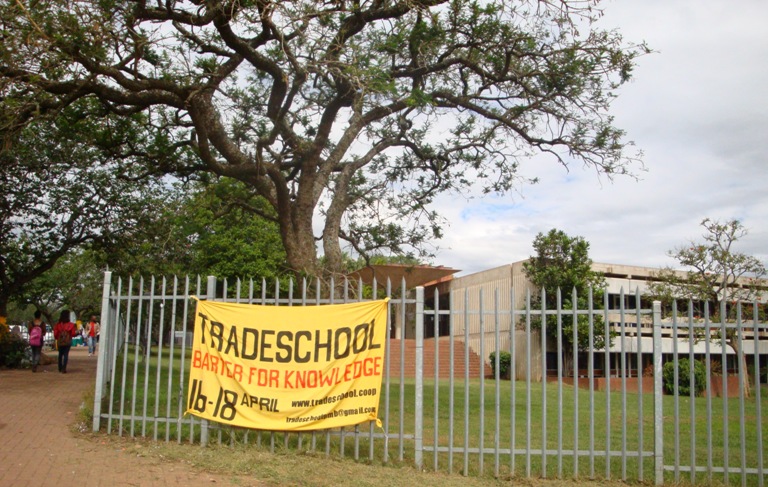
Trade School is taking place at UKZN this week.
The Trade School movement is made up of self-organised barter-for-knowledge schools across the world. It started in 2010 with a small group of friends in New York and spread to Virginia and later Milan in 2011.
Since then it reached big cities on almost every continent except Africa until April this year, when the first Trade School was run on the Pietermaritzburg campus of the University of KwaZulu-Natal by a small collective made up of staff and students, under the aegis of the Paulo Freire project of the Centre for Adult Education, School of Education.
How does Trade School operate? Trade Schools are run by a local group of volunteers who operate as a non-hierarchical collective. In a Trade School, anyone can be a teacher, and anyone can be a student, disrupting the idea that only certain people have knowledge or skills, and that people should have to pay money to learn something. It does, however, recognise that time and energy are valuable, and so classes are not free.
- It works like this:
Teachers propose classes and ask for barter items from students. These items could be anything, but the emphasis is often on time and energy, rather than things. For example, if you teach a class about knitting socks, you might ask students to bring interesting knitting patterns, or wool, or knitting needles, or demonstrate a new stitch to you or the class, or promise to donate the socks they knit to a local charity, or to pass on their skills to others; but you could also ask for fresh vegetables, or second-hand books, or to recommend a place that serves really good coffee and lets you sit and work on your laptop for hours. - Students sign up for classes by agreeing to bring a barter item for the teacher.
- Trade School is for people who value hands-on knowledge, mutual respect and the social nature of exchange.
In April, Trade School Pietermaritzburg offered 11 classes: circle gardening; philosophies of praxis and emancipation: Marx and Gramsci; instant fabric printing for beginners; Palestine 101; making beaded jewellery; common household herbs and their uses; review of Life and Worker Action; myths about rape; debate or indoctrination: teaching religion in schools; basic web design; and cooking for beginners.
Classes were taught by academic staff, administrative staff, students (undergraduate and postgraduate), and people unconnected to UKZN. Classes are typically about two hours long, although this varies from class to class; and, of course, they are open to anyone (from on or off campus).
The Trade School Pietermaritzburg Collective will be running another Trade School on the PMB campus from September 9 to 12. The collective has grown to include some off-campus people, as well as on-campus staff and students; and some classes will now be offered off-campus
Classes currently on offer:
Wednesday, September 9: 2 pm – Frantz Fanon: What more to know?; 3 pm – How to read and write Greek (in only 2 hours).
Thursday, September 10: 2.30 pm – Yoga Flow; 3 pm – Solidarity at sea? Personal experiences of the Freedom Flotilla; 3 pm – Xenophobia in SA: A governance challenge, or a war of the have-nots?; 4 pm – Belly dance for beginners; 4 pm – How to start a small business.
Friday, September 11: 2 pm – Expressive art; 2 pm – Travelling on a budget; 2 pm -Archaeology and ‘Shoreline’; 3 pm – Behind the scenes at the museum.
Saturday, September 12: 10 am – How to knit socks; 11 am – basic jewellery and bead-making; 11 am – An academic fixer; 12 noon – Making sourdough bread.
The teachers include: Kathy Arbuckle (belly dance for beginners) who learned belly dancing from a wonderful teacher, Anne Knowles, who started the Raqs Sharqi Dance Company in Pietermaritzburg; Morwenna Bosch (Yoga Flow); Kate Hoole (How to knit socks; Making sourdough bread), a journalist who knits a lot (mostly socks) and bakes her own bread; Kim Jones (Expressive art); Clint Le Bruyns (How to read and write Greek (in only 2 hours); Solidarity at sea? Personal experiences of the Freedom Flotilla), an activist, theologian and radio presenter; Tessa Naiker (Basic jewellery and bead-making); Feruzi Ngwamba (Xenophobia in SA: A governance challenge, or a war of the have-nots?), a PhD student in Policy and Development, and a lecturer in the access programme in Social Sciences; David Ntseng (Frantz Fanon: What more to know?) is an activist based in Durban working with shackdwellers and social formations who resist indignity; Stephen Phiri (An academic fixer), a lecturer and PhD student in Education and Development; Omega Shange (How to start a small business; Travelling on a budget), a young creative serial entrepreneur; and Gavin Whitelaw (Archaeology and ‘Shoreline’; Behind the scenes at the museum), an archaeologist working at the KwaZulu-Natal Museum.
Because different teachers ask for different things, the range of items varies from an open mind to a ballroom dancing lesson; from seedlings for the garden to an isiZulu conversation; from a delicious healthy recipe to unwanted exercise equipment; from old, interesting or historical posters to school sock for donating; from red wine to coloured paper of any size; from a squash session at Virgin Active Cascades to proof reading assistance for a student; from second hand books on dinosaurs to old buttons and beads you have lying around at home; from sharing to anything from your garden.
To find out more about Trade School, and the classes on offer, and to register for the classes, please visit our website: http://www.tradeschool.coop/pmb/. YOU MUST REGISTER FOR CLASSES! You can do this by clicking the JOIN button on the class you are interested in, selecting ONE barter tem you are prepared to bring in exchange for what you learn, and providing your name and email address.
You can also email us for more information at tradeschoolpmb@gmail.com.
 theluvvie